

Fear-based behavior is one of the most misunderstood challenges dog owners face. When a fearful dog freezes, lunges, barks, or avoids, owners often focus on what the dog did instead of what the dog experienced. This disconnect is where most fear-based training fails.
At Bay K9, fear-based behavior is addressed through perspective-based training—a method that prioritizes how the dog perceives the world before attempting to change behavior.
This page explains why fear must be understood before it can be reduced, how perspective-based training works, and why it produces safer, more sustainable outcomes than pressure-based methods.
What Perspective-Based Training Actually Means
Perspective-based training starts with a simple but critical shift:
behavior is driven by perception, not reality.
A fearful dog is not responding to what is happening. The dog is responding to what they believe is happening based on past experience, genetics, and current stress levels.
Perspective-based training asks:
- What does this environment feel like to the dog?
- What does the dog believe is about to happen?
- How much control does the dog feel they have?
- Is the dog choosing behavior—or reacting reflexively?
Until these questions are answered, training is guesswork.
Why Fear-Based Behavior Is Often Misdiagnosed
Fear-based responses are frequently mislabeled as:
- Stubbornness
- Disobedience
- Dominance
- Aggression
In reality, fear-based behavior is a self-preservation strategy. The dog is attempting to increase distance, stop pressure, or escape perceived threat.
This mislabeling often leads owners to apply more pressure—commands, corrections, or forced exposure—making fear worse instead of better.
For dogs already escalating, this confusion often leads owners toward dog aggression help before fear is fully understood
→ https://bayk9.com/dog-aggression-help
How Fear Changes the Dog’s Brain
Fear alters how dogs process information.
When fear is present:
- The thinking brain shuts down
- Reflexive responses take over
- Learning capacity drops
- Obedience becomes inaccessible
This is why fearful dogs may “know” commands but cannot perform them when it matters most.
The American Veterinary Society of Animal Behavior explains how fear suppresses learning and increases defensive responses
→ https://avsab.org/resources/position-statements/
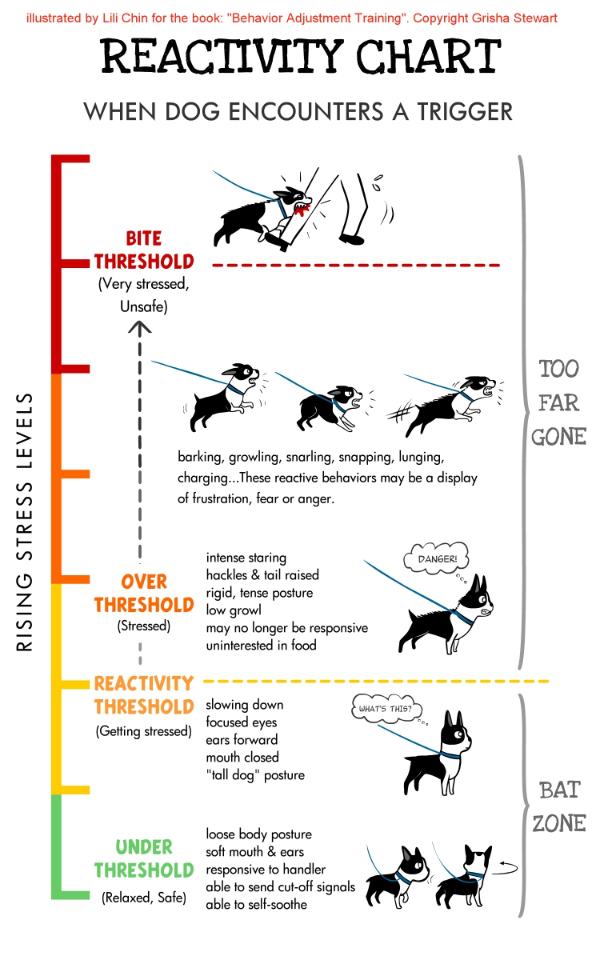
Visual Perspective Charts: How Fear Alters Perception


4
These visual models illustrate:
- How distance affects perceived threat
- How trigger stacking overwhelms coping ability
- Why reactions feel sudden but are not
- Why pressure escalates fear responses
Perspective-based training uses these insights to reduce fear before behavior escalates.
Why Exposure Alone Does Not Reduce Fear
A common myth is that repeated exposure will “get the dog used to it.” When exposure exceeds a dog’s coping threshold, the opposite happens.
Forced exposure often:
- Confirms the dog’s fear
- Removes the dog’s sense of control
- Suppresses warning signals
- Increases risk of sudden reactions later
This is why flooding and forced socialization frequently backfire, especially in busy Marin County environments.
Distance Is the Most Powerful Fear-Reduction Tool
Distance gives fearful dogs:
- Time to process
- Space to recover
- A sense of control
- Reduced pressure
Perspective-based training teaches owners to manage distance strategically instead of relying on obedience under stress.
This principle is also central to risk matrix incident analysis, where distance is treated as a primary safety variable
→ https://bayk9.com/risk-matrix-incident-analysis
Genetics and Fear Sensitivity
Some dogs are genetically more sensitive to:
- Sound
- Movement
- Novelty
- Environmental change
These dogs are not “weak” or “difficult.” Their nervous systems simply process stimuli differently.
Understanding genetics early through the genetic blueprint prevents owners from pushing fearful dogs beyond their coping ability
→ https://bayk9.com/puppy-genetic-blueprint
The Handler’s Role in Fear-Based Training
Fearful dogs learn more from handler behavior than from training drills.
Handlers influence outcomes by:
- Staying emotionally neutral
- Avoiding leash tension
- Ending exposure early
- Allowing disengagement
- Making proactive exit decisions
This aligns with Module II: The Handler’s Profile, which emphasizes that human behavior often determines whether fear escalates or resolves
→ https://bayk9.com/puppy-handler-profile-tips
Fear, Safety, and Public Responsibility
Fear-based behavior is not just a training issue—it is a safety issue.
Fearful dogs may:
- Bite defensively when cornered
- React unpredictably when overwhelmed
- Escalate rapidly in public spaces
This is why safety-oriented thinking must guide fear-based training, especially in shared environments
→ https://bayk9.com/safety-thinking-aggression
Signs a Dog Is Being Pushed Beyond Perspective Capacity
Watch for:
- Freezing or sudden stopping
- Refusal of food
- Wide eyes or scanning
- Delayed responses
- Explosive reactions after restraint
These signs indicate fear overload, not stubbornness.
What Progress Looks Like in Perspective-Based Training
Progress is not measured by obedience. It is measured by:
- Faster recovery
- Reduced intensity
- Increased curiosity
- Improved disengagement
- Calm observation at closer distances
When perspective changes, behavior follows naturally.
Final Thought
Fear-based training does not succeed by forcing bravery.
It succeeds by building safety from the dog’s point of view.
When owners learn to see the world through their dog’s eyes, fear stops being mysterious—and progress becomes predictable.
Explore related resources:
- Dog Aggression Help
- Risk Matrix Incident Analysis
- Safety-Oriented Thinking
- Data-Driven K9 Management
Fear is not defiance.
It is information.