

When dogs struggle with fear, many well-meaning owners are told the same advice: “Just expose them to it until they get used to it.” This approach—commonly known as flooding—is one of the most damaging strategies used in fear-based training.
Flooding does not resolve fear. It suppresses behavior temporarily while increasing internal stress, often leading to delayed fallout that appears weeks or months later.
At Bay K9, fear recovery is approached through trauma-informed training, a method that prioritizes nervous system safety over forced compliance.
This page explains why flooding fails, how fear actually resolves, and what trauma-informed recovery looks like in real life.
What Flooding Actually Is
Flooding occurs when a dog is exposed to a feared stimulus at full intensity without the ability to escape or disengage.
Examples include:
- Forcing a fearful dog to remain near other dogs
- Walking directly toward triggers without distance
- Restraining a dog during exposure
- Repeated exposure without recovery time
Flooding is often mistaken for confidence-building because the dog eventually stops reacting outwardly. In reality, the dog has shut down, not recovered.
Why Flooding Appears to “Work” at First
Flooding can create the illusion of progress because:
- Overt reactions decrease
- The dog stops vocalizing or moving
- The dog appears calmer
What’s actually happening is behavioral suppression, not emotional healing. The fear remains active beneath the surface, waiting for the next trigger or loss of control.
The American Veterinary Society of Animal Behavior warns that flooding increases stress and can worsen fear responses long-term
→ https://avsab.org/resources/position-statements/
How Flooding Changes the Nervous System
Fear lives in the nervous system, not the obedience center of the brain.
Under flooding:
- Stress hormones spike
- The thinking brain disengages
- Survival responses dominate
- Learning shuts down
Repeated flooding teaches the dog that the world is unpredictable and unsafe, reinforcing the original fear.
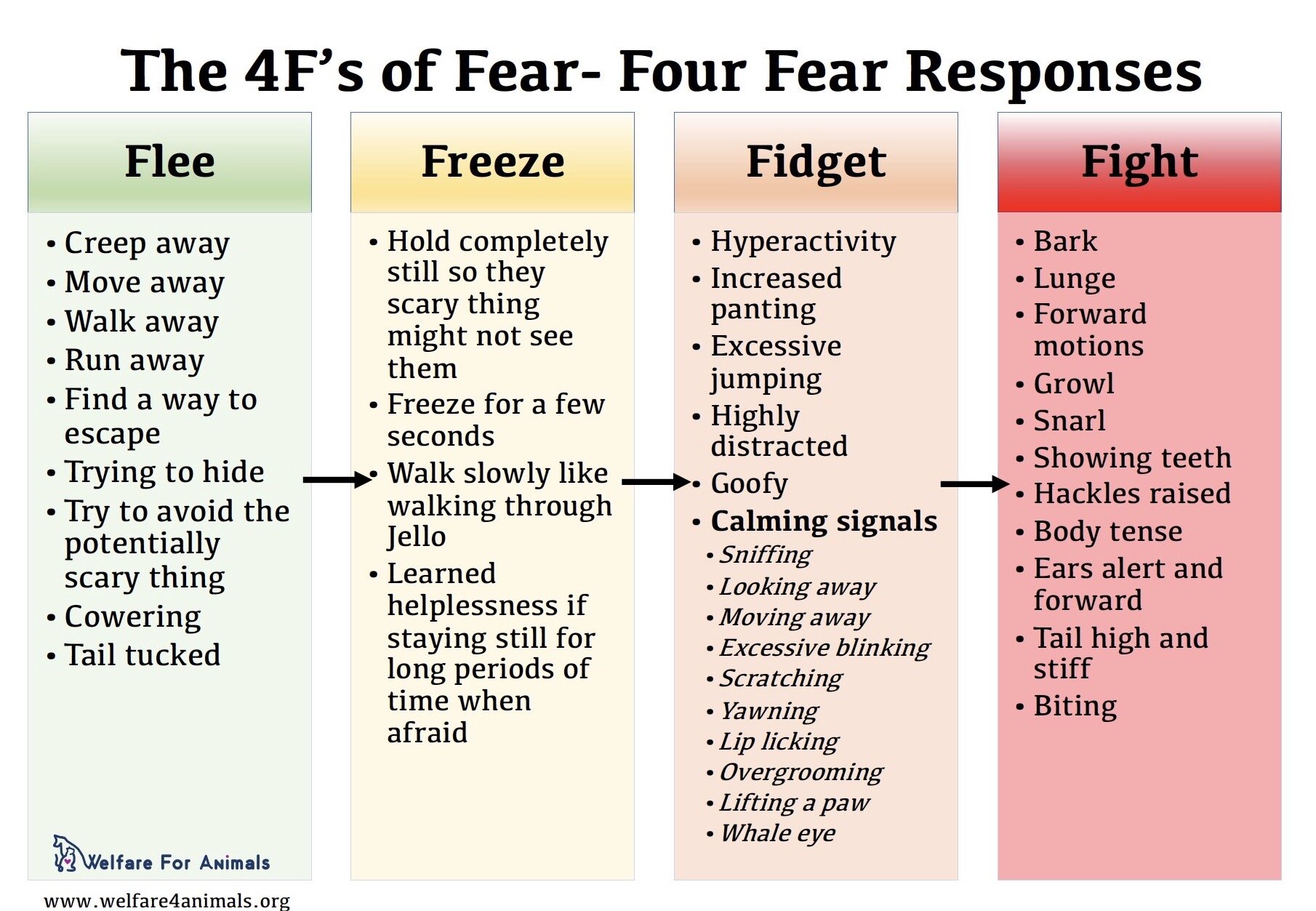


These visual models show why reactions often return stronger after suppression-based methods.
The Difference Between Fear Reduction and Fear Suppression
Fear reduction involves changing how the dog perceives the stimulus.
Fear suppression only changes how the dog expresses the fear.
| Fear Reduction | Fear Suppression |
|---|---|
| Gradual exposure | Full-intensity exposure |
| Choice and distance | No escape options |
| Nervous system recovery | Nervous system overload |
| Long-term improvement | Delayed fallout |
| Increased predictability | Increased risk |
True recovery occurs only when the dog feels safe enough to process.
Why Flooding Increases Risk and Liability
Dogs whose warning signals have been suppressed are more dangerous, not less.
Flooding often removes:
- Growling
- Avoidance
- Freezing
- Early stress signals
Without these signals, dogs may escalate directly to defensive actions with little warning. This dramatically increases bite risk and legal exposure, especially in public spaces.
This is why fear recovery must align with safety-oriented thinking
→ https://bayk9.com/safety-thinking-aggression
What Trauma-Informed Fear Recovery Looks Like
Trauma-informed recovery works with the nervous system, not against it.
Key principles include:
- Distance before exposure
- Choice before compliance
- Recovery before repetition
- Safety before progress
This approach is built on the understanding that fear resolves when the dog feels control and predictability—not pressure.
The Role of Distance in Fear Recovery
Distance is the most powerful tool in fear reduction.
Distance provides:
- Time to process
- Reduced perceived threat
- Emotional regulation
- Learning capacity
This principle is also central to risk matrix incident analysis, where distance is treated as a primary safety variable
→ https://bayk9.com/risk-matrix-incident-analysis
Genetics and Fear Sensitivity
Not all dogs process fear the same way.
Genetic traits influence:
- Startle thresholds
- Sensory sensitivity
- Stress recovery speed
- Environmental tolerance
Dogs with high sensitivity require more conservative exposure plans. Understanding genetics through the genetic blueprint prevents re-traumatization
→ https://bayk9.com/puppy-genetic-blueprint
The Handler’s Role in Trauma-Informed Recovery
Handlers influence fear recovery more than any training technique.
Effective trauma-informed handlers:
- Remain emotionally neutral
- Avoid reassurance during panic
- End exposure early
- Respect avoidance signals
- Choose exits proactively
This aligns with Module II: The Handler’s Profile, where human behavior is treated as a core variable
→ https://bayk9.com/puppy-handler-profile-tips
Why Progress Feels Slower—but Is Safer
Trauma-informed recovery often feels slower than flooding. That is because real healing happens below the surface.
Healthy progress includes:
- Reduced reaction intensity
- Faster recovery times
- Increased curiosity
- Willing disengagement
- Calm observation at closer distances
These changes signal nervous system regulation—not obedience.
When Fear Recovery Requires Professional Support
Professional guidance is essential when:
- Fear responses are escalating
- Behavior feels unpredictable
- Public safety is at risk
- There is a history of trauma
- Suppression methods have already failed
Many owners reach clarity through dog aggression help when fear-based behavior intersects with safety concerns
→ https://bayk9.com/dog-aggression-help
Final Thought
Flooding does not create confidence.
It creates silence—and silence is dangerous.
Trauma-informed fear recovery respects the dog’s nervous system, preserves communication, and prioritizes long-term safety over short-term appearances.
Explore related resources:
- Trauma Action Management Plan
- Perspective-Based Training
- Safety-Oriented Thinking
- Data-Driven K9 Management
Fear does not need force.
It needs understanding.